The Wicked Journalist of Port Huron, from Andreas 1883

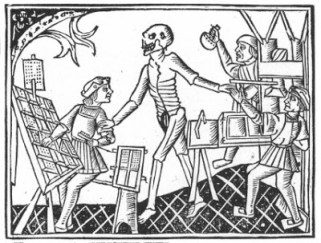
Devil's apprentices, who are "printer's devils"

Woodcut illustrating a devil and his apprentices, the printer’s devils.

Perhaps the editor Andreas* refers to in this little story took the title “printer’s devil” a little to seriously during his training.  Another example of guile and subterfuge at the local level, neighbor against neighbor.  But back to the story, which adds life to a time unknown to us.

Once there was a wicked journalist in Port Huron.  There may be wicked journalists in Port Huron now, but this wicked journalist is there no more.  Once while he was there, Elder Smart proposed to get up a revival, and went about the work systematically.  He set the date three weeks ahead, got out posters and made all arrangements to draw good houses.  The wicked journalist did not believe in revivals, and he said one day to another Port Huron editor who was not truly good, “I believe we can break  up that revival.”  The other editor thought not. 

Now it was just the time when the spelling mania was sweeping over the land.  At once the wicked editor put an item in his paper suggesting that Port Huron shouldn’t lag behind the age, and it was high time she began to spell.  T’other editor copied the item and urged Port Huron to do her duty.  The third day a call was issued for a spelling match.  In a week everybody had a spelling book in his pocket and studied at every odd moment.  Orthographic exercises  were the order of the day. 

When the time came for the revival to open, Port Huron and Sarnia were booked for an international spelling match, and Port Huronites scarcely knew whether they had souls to save or not.  They only knew they would spell the Canadians down or die in the attempt.  The revival was abandoned.  This does not profess to be a story with a moral, although it may tend to show how easily it is to set folks wild over nothing, and how like sheep they will go astray, or any other way, when some one chooses to lead them.

From History of St. Clair County, Michigan (Chicago: A.T. Andreas & Co, 1883), page 506.

Substitute HB 5232 Bills to Weaken Historic Districts Not Necessary

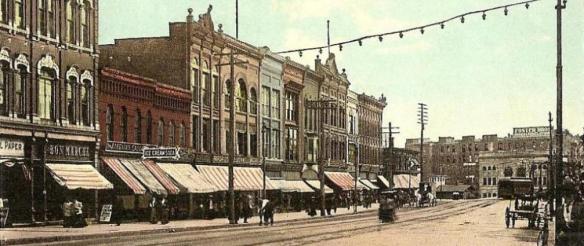
A Main Street boardwalk view of Portland, Michigan.

Historic main street, boardwalk view, Portland, Michigan.

Earlier, PHAHPA posted an alert from the Michigan Historic Preservation Network, asking those of us who favor historic preservation in Michigan to write our representatives, voicing our opposition to House Bill 5232 and its senate twin SB 720.  The house bill had gone to the Local Governments Committee, where a substitute bill was adopted (on February 24th).  In the meantime, the representative who introduced the original bill, Afendoulis, wrote a substitute bill as well; it was not introduced to the Local Governments Committee before they went on spring break (which lasts until April 11th), however.  While some of the changes in the substitute bills make the proposed changes to the original historic district law (PA 169 of 1970) less severe, they would nevertheless weaken that law and are simply unnecessary.  Why this is even an issue is quite disturbing, and can be read about in Affluent Suburb Behind Push to Dismantle Michigan Historic Districts.

This is what our tax dollars are spent on in Lansing . . .to make our local communities less self-governing.

“The beauty of this system is that its a democracy,” Ligibel says. “Because it’s so local, each community decides for itself, and things change over time.”  Burg 3/9/16

Continue reading

Winners of the 2016 Governor’s Award for Historic Preservation

Michilimackinac archaeology

Archaeological investigations continue at Michilimackinac.

In this time of attack on historic districts coming out of Lansing, it’s refreshing to read the recent announcement of the 2016 Governor’s Award for Historic Preservation winners.  The awards recognize the work of many persons, organizations, and companies that help to research, preserve, and rehabilitate the state’s irreplaceable cultural resources.  This year’s awards, which will be presented publicly in May (Historic Preservation Month) in Lansing, are as follows:

  • For the archaeological investigation of Fort Michilimackinac: Mackinac Island State Park Commission.
  • For the Indian Village Historic Streetlight Rehabilitation Project, Detroit: Indian Village Historical Collections, City of Detroit, Public Lighting Authority, DTE Energy, Offshore Spars, SS Stripping/CDS Performance Coatings, Corby Energy Services, and Consulting Engineering Associates, Inc.
  • For the rehabilitation of the St. Joseph North Pier Inner and Outer Lights: City of St. Joseph, Smay Trombley Architecture, Mihm Enterprises, the Heritage Museum and Cultural Center, the Lighthouse Forever Fund and the Citizens of St. Joseph.
  • For the rehabilitation of Dearborn City Hall Complex: City of Dearborn, Artspace Projects, Inc., Neumann/Smith Architecture, the Monahan Company, and the East Dearborn Downtown Development Authority.
  • For the rehabilitation of Fremont High School, Fremont: Home Renewal Systems LLC, Quinn Evans Architects, and Wolverine Building Group.
  • For the Mount Pleasant Indian Industrial Boarding School archaeological investigation: The Saginaw-Chippewa Indian Tribe of Michigan, Central Michigan University Department of Sociology, Anthropology and Social Work, and the City of Mount Pleasant.

A list of the 2015 winners can be seen at Five major historic preservation projects honored with Governor’s Awards.

Primary Source: Indian Village, City of Detroit recognized for historic streetlight rehabilitation project.

In Detroit: “Injecting Old Spaces with New Ideas.” Love it!

Please enjoy the awesome 4+ minute video below that excites as it informs:  Vacant not Blighted: Revitalizing Detroit (by MHPN).  Detroit’s historic assets are being creatively reused, and many await a loving rebirth.  I’m not from Detroit, but almost . . . geographically.  We lived in the suburbs (a poor one, not the kind with paved streets and horses), and while my dad worked in Detroit, we otherwise avoided that city like the plague.  Probably the race riots of 1967 (which I lived through) had something to do with it.  No doubt my dad experienced a great deal of the tension building up to those riots where he worked (a large retail company’s warehouse).

Continue reading

Problems with anti-historic district rhetoric

Below is a reprint of an article posted by Justin Davidson in the New York Magazine, Daily Intelligencer.  Please go to the article for further citations and the comments section.   I just want to add that a lot of the rhetoric revolves around ideas like:  wealthy people just want to keep their neighborhoods nice (who wouldn’t want that?) and high valued, but, we should be FOR higher density in our communities.  I support historic preservation for lots of reasons, and I’ve never been wealthy.  Historic preservation is about valuing quality materials and design, human scale and unique cultural environments.  It’s not about stopping progress or making our own history, but instead about keeping what’s of human value from our past.  I’m not for dense cookie-cutter communities made out of glorified cardboard, and I’m not for residents losing control of their communities in order that wealthy, powerful, corporate interests can do whatever they please.  I like what one commenter (JamieGlas) wrote:

“It depends.” This kind of nuance seems lost on the CityLab crowd that wants to impress you with Supreme Court decisions and grandiose “rhetorical blowtorches” that break down in almost any case study. There’s only a set of abstract pro-development rules. you kind of get that the authors position is a misguided political one not an architectural or social one. If quality is not a value we preserve, it won’t be a quality we value in future construction either.

The Atlantic’s Anti-Historic-District Argument Is Wrong and Extreme

Over at The Atlantic’s urbanist magazine-in-a-magazine, CityLab, writer Kriston Capps turns a rhetorical blowtorch on the concept of the historic district, particularly in residential neighborhoods. Family homes don’t warrant protection, he argues, because, well, they’re homes, and people should be able to do what they want with them. Whole clusters of homes are even less deserving of protection, he argues, in a multipronged, bipartisan case — none of which I buy.

Continue reading

Pending Bills Would Greatly Hurt Local Preservation Efforts

Port Huron, Huron Ave post card

House and Senate bills were introduced to the Michigan legislature last month that would deflate community efforts to control their own local historic resources.  The proposed amendments to the state’s historic districts law go against existing and long-standing federal laws and the accomplishments made at the state and local levels.  The bills also totally oppose what citizens desire regarding historic preservation efforts as outlined in Michigan’s State Historic Master Plan, 2014-2019.  Instead of reinventing the wheel, reproduced below is Michigan Historic Preservation Network’s  Advocacy Alert concerning HB 5232 and SB 720.  Links to sample letters for your ease of advocacy are included. ___________________________________

Michigan Historic Preservation Network

Advocacy Alert: Historic Resources in Jeopardy with HB 5232 / SB 720

We need your urgent attention and immediate action. On January 26th, Rep. Chris Afendoulis, R-Grand Rapids, and Sen. Peter MacGregor, R-Rockford, introduced identical legislation into the Local Government Committees of the House and Senate. House Bill 5232 and Senate Bill 720 have serious detrimental impacts to historic resources and local historic districts through proposed amendments to Michigan’s Local Historic Districts Act, PA 169 of 1970.

Continue reading

What We Have Lost

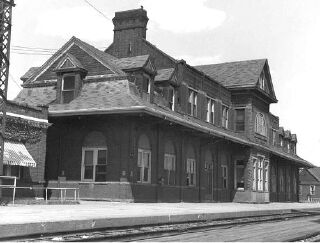
"The Tunnel" GTW Depot, PH, built 1891

This substantial historic railroad depot (Grand Trunk Western) built in 1891, was torn down in 1975, yet the lot remains empty.

By Vicki Priest (enlarged and edited on 3/31/16)

Buildings aren’t people, yet buildings can be unique, beautiful, contain rare materials and can be a face in the community for centuries.  A building can represent a street, a community, a city; it can inspire awe and any number of other feelings or thoughts that make us realize that we can create something beautiful.  Buildings can be the opposite, too.  They can remind us of failing economies and the loss of community pride, as when a school falls into disrepair, or when newer buildings are simple, cheap, cookie-cutter, letting us consider how we now live in a throw-away culture.  For example, 805 Pine Grove Avenue used to be the home of an astonishingly handsome home (Second Empire style), but in its place now is an abandoned gas station.

Pine Grove Ave, PH, 2016

Abandoned gas station at 805 Pine Grove Avenue, Port Huron, today (2016).
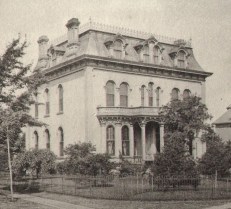
Dead house, 805 Pine Grove Ave, PH

An early and astonishing Port Huron home, demolished (!) in 1970. 805 Pine Grove Avenue.


Looking through images of houses and churches that have been razed in Port Huron, I was negatively impressed by the loss of some of the city’s most notable architecture.  It’s very hard to imagine how it could’ve been thought that tearing such structures down was better than brainstorming ways to repurpose them.  Other structures were lost due to neglect and fire. Below is a very sad example of the urban downscaling that has happened in Port Huron.  The first image is of an undated photo, showing a block of historic buildings on the left (one of them was quite unique), with the second image showing them all to be gone.  (These images will be updated when more information and better quality photos are acquired.)

Military and Wall streets, Port Huron

With the Harrington Hotel at the right, this view is of a block of historic structures at Military and Wall streets (NW corner), Port Huron. The sidewalk and streets are of brick pavers. Undated photo from Gaffney (2006, p 24).

Military street at Wall Street, NNW view, Google

The same scene in 2013 as the historic image shows, though with a different type of lens. No historic buildings at the left remain. From a Google street view image.

Some homes made way for the primary hospital in town.  While time doesn’t stand still and communities grow, the homes torn down for the hospital expansion didn’t have their windows and other structural and architectural components removed for recycling purposes (for use in other historic structures that need replacements).  Below are some examples.  An inventory of lost resources will be listed in the Lost Properties page.

1st Baptist Church, PH, now a parking lot

First Baptist Church, dedicated in 1882 (the church had an earlier building that had burned down). Sold in 1969 to make a parking lot.

The beautiful church structure at left was considered the “crown jewel” of downtown Port Huron (Creamer 2006).  It was sold to the city in 1969 and subsequently demolished; there is now a parking lot in its place.

Maccabees headquarters, Port Huron.

The original Knights of the Maccabees headquarters, built in 1892. It later became the Algonquin Hotel. It met its unfortunate demise in 2000, when it burned down after having been abandoned. Photo from c. 1905.


Below are the homes mentioned earlier, demolished in 2006 for the hospital expansion.  They do not appear to have had valuable components removed first.

Razed house, Pine Grove Ave, Port Huron

The 1300 block of Pine Grove Avenue, Port Huron, 2005, prior to their 2006 demolition.

Demolishing 1327 Pine Grove Ave., PH

1327 Pine Grove Avenue being demolished. June 2006. The smashed remains of the regal 1323 home are to the left.

Razed Lauth Hotel, Port Huron

The Lauth Hotel, built in 1902. Date of photo unknown.

Very few of the original hotels in Port Huron remain today.  Sadly, the “skinny” Lauth Hotel (and bar) no longer stands.  “Built to resemble the famed Flat Iron Building in New York City in 1902, it was destroyed in the Urban Renewal Movement of the 1970’s” (Gaffney, accessed Feb 2016).  Instead of creatively integrating it into condominium architectural plans, it was simply razed.  The whole area where it stood used to be an attractive little city center with brick pavers, but not any more.

__________________

PS.  A local authority had told me of this house, and having discovered specifically which house it was in Port Huron, I wanted to append it to this article.  St Joseph Catholic Church had owned it and then demolished it, despite it being in the city’s Olde Town Historic District.  Believers are called to be stewards of God’s creation, and quality buildings are made of choice and rare materials that God provided.  The workmanship required to make such structures may also be considered a gift from God.  Apparently, the community wanted this structure saved, the city offered them free amenities, and there was even someone who wanted to move it.  Yet the church acted ungraciously (from what I’ve been told) and tore the building down anyway.  Why such waste when it could’ve been removed instead?  There is nothing but grass there now.  There are many reasons why The Church has dwindled in the last decades, and this attitude of disregard–for others in the community and for God’s gifts–could be one of them.
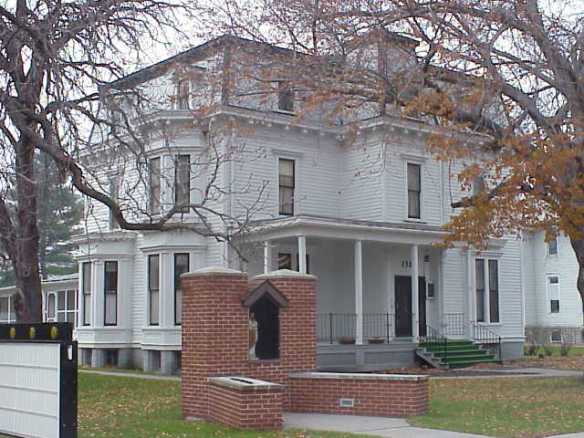
317 Seventh St, Port Huron, demolished

1317 Seventh Street, Port Huron. The church that demolished it, which was on an adjacent lot, even took over the address of the disappeared.

Sources

Bromley, Suzette (former curator for the Port Huron Museum), Rootsweb page, which holds scanned images from various collections held by the Port Huron Museum, and the Library of Congress.

Creamer, Mary Lou (and the History and Research Committee of the Port Huron Sesquicentennial Steering Committee, c. 2006), Port Huron: Celebrating Our Past, 1857-2007.

(TJ) Gaffney’s Pinterist page

Gaffney, TJ, Port Huron, 1880-1960 (Charleston: Arcadia Publishing, 2006).

Olde Town Historic District

PhoenixMasonry.org
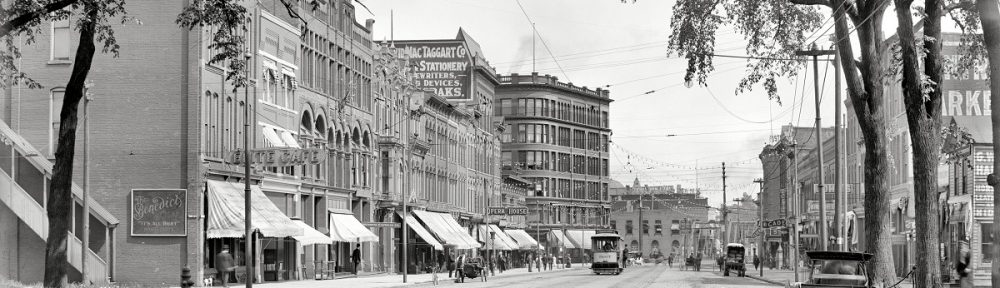
Hello!

This brand new site is under construction.  Priority right now is the populating of the informational pages rather than posting lots of entries on the home page.  So if you check those out, you’re sure to see something.

At the moment, the City of Port Huron doesn’t have a central informational hub for its own resources or for historic preservation information generally,* and that is exactly what this site hopes to help rectify.  For example, Port Huron has two historic districts, but you’d hardly know it even if you tried finding out about them.  City governments that are proud of their rich built environment and history normally try to make those resources easily knowable, even more so when heritage tourism is involved.  There are those who are active in trying to preserve their communities, and there are those who are working on projects right now that will result in the reopening of historic buildings downtown.  These things will be the subjects of future posts.  Regarding the association, it is just forming and looking for supporters, members, friends.  If you are interested in knowing more or helping out, there is a contact form on the “membership and donations” page.  Thank you for your interest!

*  The St. Clair County library in downtown does (happily) have research materials, and there is some information at the Main Street office at 219 Huron Avenue, but neither of these are the equivalent to the city having a real history or historic preservation page (or publications).  The city has never carried out a historic resources survey and has no register of historically significant properties, and the two historic districts it has are hard do find out about (one district has a website up, but it hasn’t been updated since 2008).  The communities that surround Port Huron, Fort Gratiot, Port Huron Township, and Marysville, are smaller and haven’t undertaken surveys or implemented registers, either (Marysville does have historical and museum information at its city site).

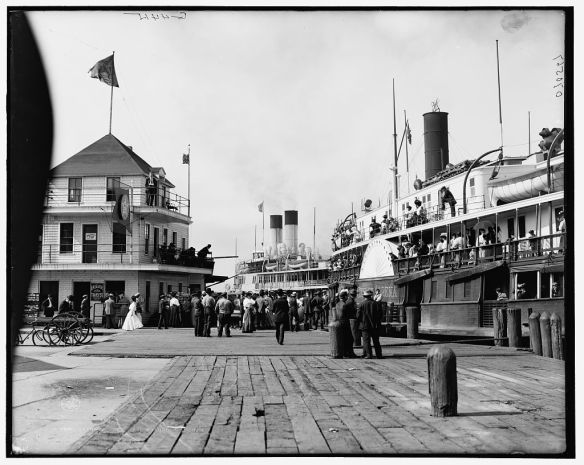
Port Huron, pier with steamers, c 1908

An active pier scene in Port Huron, circa 1908.