South Park Historic District Moving Forward

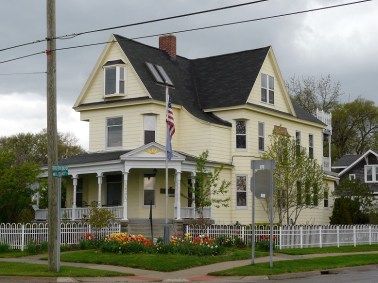
3803 Electric Avenue, known as the Conner House. It is one of the earliest South Park homes and was depicted in a Factory Land Company booklet (ca 1902). George Conner was an industrial inventor and promoter of important South Park companies. A street in South Park is also named after him.

3803 Electric Avenue, known as the Conner House. It is one of the earliest South Park homes and was depicted in a Factory Land Company booklet (ca 1902). George Conner was an industrial inventor and promoter of important South Park companies. A street in South Park is also named after him.

With the preliminary questionnaire accepted by a Michigan State Historic Preservation Officer, further study and considerations of boundaries for the South Park Historic District are moving forward.  To show our progress, an excerpt from the preliminary questionnaire is given below (the formatting was changed because of website conditions, however).  It is a concise consideration of the early period of the district.


A Concise History of South Park: Beginnings and Early Development

By Vicki Priest (2016) (c) (Not to be used without permission of the author)

What is known as South Park, at the south end of the City of Port Huron, began in 1901[1] as a planned community that had minor similarities to a company town.  Unlike any other turn-of-the-century neighborhood or town known in the region, South Park was designed with a long (east-west) central park which was to be surrounded by homes, while the community’s north end was reserved for commercial enterprises and industrial plants.  Employees could buy lots (sometimes with houses already built on them) directly from The Factory Land Company, the owner and promoter, with easy terms.  And aside from some minor stipulations,[2] research so far suggests that neither the Factory Land Company or any associated company controlled residents or owned commercial businesses in the manner that traditional company town developers did.

Continue reading

Fun Stuff from Department of Labor Reports

PHE&TCo buildings. partial, Port Huron 2016

Not a pretty sight today, but the Port Huron Engine & Thresher Company was Port Huron’s top employer in 1916 (and very likely, many other years as well).

By Vicki Priest (c)

Perhaps the majority of people don’t get excited about some of the things I do . . . but Department of Labor Reports!?  I love hardware stores and let out little exclamations over finely designed metal objects.  So there’s that tomboy side of me (or engineer nerd?).  But the historian side of me, the Sherlockian part of me, was very excited indeed to find a Michigan Department of Labor Report from 1916 that listed businesses inspected in Port Huron.  Although the data is from “factory inspections,” those entities inspected were not only factories, but included businesses that simply provided a service (no doubt not ALL Port Huron businesses were inspected).  A really useful bit of information provided is the founding years of these companies (most of them, anyway).  Here are some culled facts from this 1916 report (hopefully, more years to come later).

Continue reading

Practical Reasons to Save Old Buildings: Thank You, National Trust

One view of the magnificent Mission Inn, Riverside, California. There are many astonishing views to this building. This building took a TON of effort and money to renovate. Worth it? Of course, with all the quality materials and workmanship this group of buildings contain, besides the almost limitless amount of design details.

One view of the magnificent Mission Inn, Riverside, California. There are many astonishing views to this building. This building took a TON of effort and money to renovate. Worth it? Of course, with all the quality materials and workmanship this group of buildings contain, besides the almost limitless amount of design details (elements of “intrinsic value,” as mentioned below). See an interior shot of the multi-level, huge round stairwell, below. And see more at http://www.missioninn.com/photo-gallery-en.html

The National Trust for Historic Preservation is simply a great organization with all kinds of useful information for planners, preservationists, history buffs . . .  Last fall they posted a “Six Practical Reasons to Save Old Buildings” at their site, but I only saw it recently.  It would seem like a place like Port Huron would have learned something by now about the loss of so many of its historic buildings, the built enviornment that made Port Huron what it is–well, what it was.  Most of the buildings lost (including whole blocks of historic commercial structures) have not been replaced by anything better, or even equivalent, in monetary or aesthetic value. (Historically speaking, I remain surprised every time I come across a building that had been moved because someone valued it–the thing had value; buildings used to be moved a lot more than people today realize, I’d wager.)

If a city can be likened to a person, it’s as if Port Huron is an aged lady who hated her own old body, so cut parts of it off, thinking her appearance would then look more appealing (she sought to hide her age, too, by not posting about her past on her website).  But she didn’t add anything to her appearance by slicing away at herself; she was only left with the reality that there was now less of her, and, she didn’t look any better.  There are those who appreciate the weathered, older, and wiser folk, and seek them out.  And despite so many people telling her just this thing, she still can’t seem to like her old self.  She had glory days for sure, and people feel a little bit like they are a part of that, still, when walking through the remnants of those days.  They connect with those who came before, somehow, instead of just blandly passing through a plastic and drywall matrix of cookie-cutter walls.

I want to imagine what it was like when William Jenks walked down the same street that I’m now walking on, and think about what it was like in a restaurant where he and his buddies talked about the growing city, the ship they were building, how the ball was in so-in-so’s house on the third floor the night before, etc.  Unfortunately, I don’t know if there are any buildings left that held a restaurant or lounge that William Jenks might have socialized in, and I don’t know yet if any of the remaining large homes still have their third floor ballrooms.  But, I hope you get the picture.  Perhaps you have different thoughts of the past in Port Huron, like imagining a 1920s scene of beach revelers.

So, what are the practical reasons for saving old buildings?  I’ll provide you a shortened list of what the National Trust provided.

  1.  “Old buildings have intrinsic value.”  I’m going to be a bit jaded here and say that a lot of folks wouldn’t know what “intrinsic value” means.  But here the author talks about the value of the materials and craftsmanship used in older, pre-WWII buildings.  You just can’t get many of these materials any more, and you often can’t reproduce the quality or craftsmanship.  Example:  old building in Tennessee was saved from the wrecking ball after realizing that it’s thick brick walls (five layers!) could withstand the most powerful tornadoes.
  2. “When you tear down an old building, you never know what’s being destroyed.”  Another example from Tennessee (the Daylight Building, built 1927).  A building became an eyesore, as so many altered and then uncared for buildings do.  Someone finally wanted to renovate it instead of demolish it, and it turned out to have qualities that no one knew about:  “drop-ceilings made with heart-pine wood, a large clerestory, a front awning adorned with unusual tinted ‘opalescent’ glass, and a facade lined with bright copper.”
  3. “New businesses prefer old buildings.”  Older buildings are perfect for smaller businesses and start-ups.  Businesses with new and therefore possibly risky, ideas, need the economy of existing infrastructure.
  4. “Old buildings attract people.”  I would say the reasons for this attraction include the human scale and the attention to, and value of, detail.  Those who came before us stopped and looked at the roses, and smelled the roses, and said that the roses were very good.  Today, builders don’t seem to even know roses exist, let alone have value.  But the author had these ideas about it:  “Is it the warmth of the materials, the heart pine, marble, or old brick―or the resonance of other people, other activities? Maybe older buildings are just more interesting.  The different levels, the vestiges of other uses, the awkward corners, the mixtures of styles, they’re at least something to talk about. America’s downtown revivals suggest that people like old buildings. Whether the feeling is patriotic, homey, warm, or reassuring, older architecture tends to fit the bill.  Regardless of how they actually spend their lives, Americans prefer to picture themselves living around old buildings.”
  5. “Old buildings are reminders of a city’s culture and complexity.”  “Just as banks prefer to build stately, old-fashioned facades, even when located in commercial malls, a city needs old buildings to maintain a sense of permanency and heritage.”
  6. “Regret only goes one way.”  Like anything else, once a historic structure is gone, it can’t be resurrected.  We can’t tell the future, and the future might’ve been better with the use of that now-gone building.
Mission Inn, interior stairwell

This building took years to renovate. Many other renovation projects take much less time, expense, and aspirin, but result in appreciated and livable, if now awe-inspiring, spaces just the same.

Mission Inn, Riverside

I couldn’t help it . . . had to add another. The bottom portion of this photo does not represent the bottom floor! This is truly an amazing building, in what seems an unlikely place far outside of Los Angeles. But, people used to take a train here, and elsewhere (the track was a large figure 8) in the desert, before autos changed everything.

“Homeless” Then and Now (“Don’t pay for the landlord’s house”!)

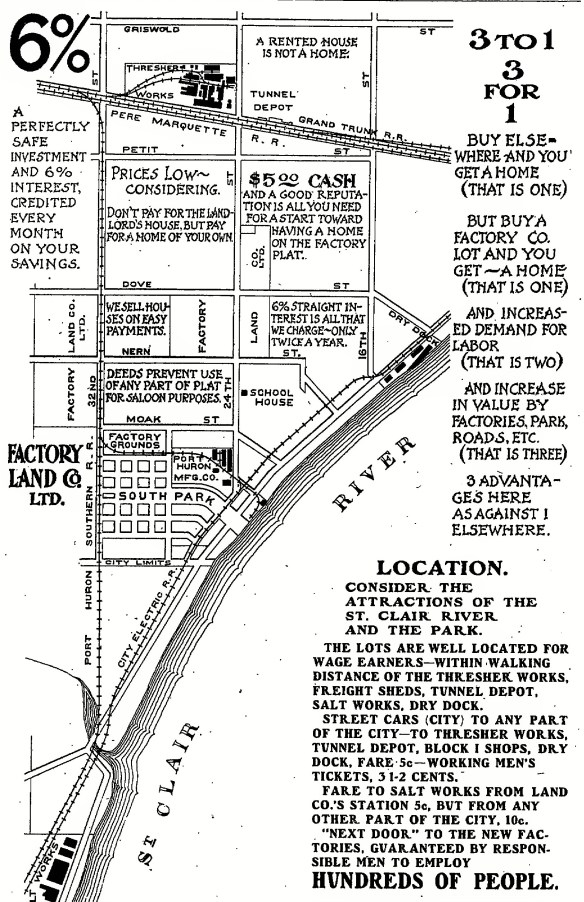
Port Huron, Factory Land Company booklet, ca 1902

Factory Land Company booklet, ca 1902, page 30.

Today, we’d never think of a homeless person as someone who is living in a rental, yet that’s exactly what at least some thought (or tried to make a point about) in Port Huron at the turn of the century (19th/20th).  The following was reprinted from “Home and Fireside” in the Factory Land Company’s promotional booklet, circa 1902-1903 (page 18).

______________________

All Homeless People are not Poor

“What a dreary sound the word ‘homeless’ has!  It is associated in the mind with loneliness, hunger and threadbare clothing.  Yet all homeless people are not poor.  Some of them are merely unwise.  They continue to live in houses owned by others, when they might with the same expenditure possess a home of their own.  To be sure, they have a temporary abiding place–a habitation–which, by a pleasant though strained fiction, they call ‘home.’  But they pay rent–a tax–for it.  Why not have the papers drawn differently?  Instead of a lease, let it be a deed, and the monthly payments that now disappear and are gone, leaving you as homeless as ever, will remain with you. . . .”

________________________

The Factory Land Company goes on to say, “A rented house is not a home,” and who can’t testify to that?  They add, “Don’t pay for the landlord’s house, but pay for a home of your own” (page 19).  Who wouldn’t want their own home?  The Factory Land Company lands, known as South Park in Port Huron, represented an early form of urban planning.  South Park was not a traditional company town–it didn’t have the drawbacks that Pullman, Illinois, had–but had aspects of those types of “communities” while adopting ideals from the City Beautiful Movement.  Workers weren’t to rent, but buy their homes and/or lots at a good price with practical terms ($5 down and then $1 a week).  They could walk to work, live alongside (or very nearby) a large park and the beautiful St. Clair River, and take the modern electric railway to Port Huron, Marysville, or even Detroit.  Sounds delightful!

What a contrast to being “homeless!”  And, of course, it was not the gilded cage that Pullman was.  In Pullman, the workers could only rent from the company, and in 1893 when the company cut wages but not rents . . . well, the most well-known and influential strike rocked America (this happened in 1894).  The promoters of South Park seemed to have understood quite well what would appeal to workers and employers alike a few years after this strike.

_______________________

The Successful Man

A successful man is one who has made a happy home for his wife and children.  No matter what he has done in the matter of achieving wealth and honor, if he has done that he is a grand success.  If he has not done that, and it is his own fault, though he be the highest in the land, he is a most pitiable failure.  I wonder how many men, in the mad pursuit of gold, which characterizes the age, realize that there is no fortune which can be left to their families as great as the memory of a happy home.  —-Ella Wheeler Wilcox. (Factory Land Company page 23)♥

________________________

♥  Someone was reading something more than business journals and financial reports!

Sources (not already linked to)

Factory Land Company.  Manufacturing and Homes in Port Huron, Michigan (Port Huron: Press of the Port Huron Engine & Thresher Co: no date [ca. 1902-1903]).

Green, Hardy.  The Company Town: The Industrial Edens and Satanic Mills that Shaped the American Economy (New York: Basic Books, 2010).

Port Huron Loan and Building Association.  Home and Fireside (no date).

As Seen in Port Huron, April 24th 2016

Backways, Port Huron

The alleyscape of the southeast block of Military and Water Streets, Port Huron (taken April 24, 2016; filtered).

The lull in posts should not be confused with an absence of work on PHAH&PA’s part.  Research is being done, pages are being added to and edited, buildings and districts are being identified as possible National Register candidates, one-on-one meetings are being held, and there’s some training going on in there too.

Part of the page additions and research has involved taking and adding photographs, so I thought I’d share some here.  Today, not realizing that the Exquisite Corpse coffee house wasn’t open on Sundays, my son and I took a little stroll around the block it’s in, looking for the little things that make up the personality of a building and a block.  Here are a few.

Historic alleyway door and wall, Port Huron.

Old stonework and double door, Military street alley (at Water Street), Port Huron. I only wish you could really see what this photo can’t seem to convey about this historic doorway.

Pilaster detail, Water St, Port Huron

Pilaster detail, east end of Water St, Port Huron.

Historic bldg details, Port Huron

Stone foundation and pilaster detail, east end of Water Street, Port Huron.

Pilaster base, north end Military St, Port Huron

We’d need to do a rubbing of this one. Pilaster base, at the north end Military St (east side), Port Huron.

Historic interior detail, Military St, Port Huron

Historic interior detail (or ghost of one), east side of Military Street (south of Water), Port Huron. East Lake Builders seem to be in the process of preserving and renovating this building.

Detail of the Old Masonic Lodge Bldg, Port Huron


At left is an upper door detail from what’s left of the 1912 Eagles Lodge No. 343 at 1001 Military Street. It used to be a stately three story structure with brick upper floors, but now only the bottom first floor remains (it is utilized as a social services building). See below. An image of the original building will be added when one becomes available.

1001 Military St, Port Huron

Below is a side view of what is probably the only red sandstone building in Port Huron, and it’s in pretty sorry shape.  This structure was one of the oldest banks in the city, St. Clair County Savings Bank.  Amazingly, it’s present location at Military and Pine streets is not it’s first–it was moved stone by stone from a location that was closer to the water (Endlich 1981:71).

Old St Clair County Bank bldg, Port Huron

St Clair Cty Savings Bank Endlich p72

At left is a scan of the building during better days (Endlich 1981:72); the photo is undated.

Source

Endlich, Helen.  A Story of Port Huron (Port Huron: Self-published, 1981).

Getting the Word Out about PHAHPA

I’ve been busy populating this site’s pages with useful information, researching and helping some folks with historical building questions, and trying to make more connections.  So, I hadn’t been focusing on developing the organization as a nonprofit quite as much.  But to make things clearer in everyone’s mind (including my own), I came up with a one page hand-out about the Port Huron Area History and Preservation Association.  Eventually, when the organization has a new host, pdf’s of forms, informational sheets and brochures, articles, etc., will be made available.

In the meantime, feel free to comment on the contents of this hand-out.  We would appreciate thoughtful feedback and any insights into the local situation that could prove helpful to furthering the preservation of our historic community.  First is an image of the sheet which could be copied and printed out, if desired, followed by standard text.

Port Huron Area History

The background color is quite off in this scan, but it’ll do for now.


Port Huron Area History & Preservation Association  

Community.  Uniqueness.  Home.

cropped-ph-1st-baptist-1867-2.jpg

Bringing the Port Huron area’s history to life.

We’re here to inform and inspire Port Huron area residents about the possibilities of preserving and rehabilitating their historic properties.  We’re here to help those same residents investigate their properties for the purposes of recognition, preservation, and the application for any possible monetary benefit or assistance.

We will do this by developing and presenting (1) data related to regional history, architecture, and planning, (2) historical narratives and contexts, (3) “how-to” articles and ready-to-use forms; by providing (4) assistance with research, technical forms, and report writing, and by (5) recognizing historical resources at the organizations’ web page and via public avenues, and when funds allow, (6) provide permanent informational plaques (to be mounted on the historic building). 

We are still in the development phase of establishing this organization for the greater Port Huron area, with the goal of incorporating and being awarded nonprofit (501[c]3) status.  To find out more and to contribute in any way (including volunteering, or even being on the Board of Directors or an advisory committee), please visit PHAHPA.ORG and/or contact Vicki Priest at 949-449-4731 (or phahpa@zoho.com).  Thank you!


Yes, Virginia, Historic Preservation for the Masses Exists

Playful architecture, Port Huron

A historic house of concern, located at 1440 Chestnut, Port Huron. It has an unusual and playful very wide and deep-set tower, which dwarfs the small bay window behind it. There is another home with these same surprising features in South Park, Port Huron.

Against the will of a huge amount of people and their community representatives, monied interests in Michigan are trying their darnedest to–for all intents and purposes–eliminate historic districts (Ellison 2016; Finegood 2016 (1); Finegood 2016 (2)).  So with this dark cloud looming, Stephanie Meeks’ “President’s Note” in the Spring 2016 issue of Preservation (Fighting Displacement) seemed like a sudden burst of sunshine.  To read the entire piece, click the previous link–it’s not a long read.  But here, let me give you some highlights.

For many Americans in cities, the biggest crisis now and in the foreseeable future is a dearth of affordable housing . . . Simply put, the rent is just too high. . . .  Fourteen cities around the country saw double-digit growth in rents last year.

There is sometimes a perception that preservation is driving excessive rents by making older neighborhoods more attractive to well-heeled outsiders, and by ostensibly limiting the housing supply. We have been heartened by recent research . . . that suggests instead that preservation supports existing residents across the economic spectrum . . .

One terrific example of this is in Macon, Georgia, where the Historic Macon Foundation has been renovating homes in the Beall’s Hill neighborhood. Historic Macon never displaces current landowners by acquiring occupied houses [displacement is happening in Michigan, where very nice old homes are being torn down to build “McMansions], and it counters displacement in other ways, such as building houses designed to be affordable for families and operating a robust historic tax credit consulting service.  [emphasis mine – this is a terrific idea]

Rather than exacerbating the crisis, creative adaptive reuse projects all over the country are expanding housing options and helping cities become more affordable.

I wonder what we can accomplish at the local level here in Port Huron, if we try?  Please contact me if you’d like to discuss the possibilities!  vicki@phahpa.org

The Wicked Journalist of Port Huron, from Andreas 1883

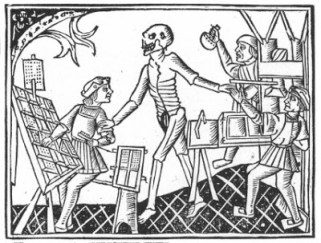
Devil's apprentices, who are "printer's devils"

Woodcut illustrating a devil and his apprentices, the printer’s devils.

Perhaps the editor Andreas* refers to in this little story took the title “printer’s devil” a little to seriously during his training.  Another example of guile and subterfuge at the local level, neighbor against neighbor.  But back to the story, which adds life to a time unknown to us.

Once there was a wicked journalist in Port Huron.  There may be wicked journalists in Port Huron now, but this wicked journalist is there no more.  Once while he was there, Elder Smart proposed to get up a revival, and went about the work systematically.  He set the date three weeks ahead, got out posters and made all arrangements to draw good houses.  The wicked journalist did not believe in revivals, and he said one day to another Port Huron editor who was not truly good, “I believe we can break  up that revival.”  The other editor thought not. 

Now it was just the time when the spelling mania was sweeping over the land.  At once the wicked editor put an item in his paper suggesting that Port Huron shouldn’t lag behind the age, and it was high time she began to spell.  T’other editor copied the item and urged Port Huron to do her duty.  The third day a call was issued for a spelling match.  In a week everybody had a spelling book in his pocket and studied at every odd moment.  Orthographic exercises  were the order of the day. 

When the time came for the revival to open, Port Huron and Sarnia were booked for an international spelling match, and Port Huronites scarcely knew whether they had souls to save or not.  They only knew they would spell the Canadians down or die in the attempt.  The revival was abandoned.  This does not profess to be a story with a moral, although it may tend to show how easily it is to set folks wild over nothing, and how like sheep they will go astray, or any other way, when some one chooses to lead them.

From History of St. Clair County, Michigan (Chicago: A.T. Andreas & Co, 1883), page 506.

What We Have Lost

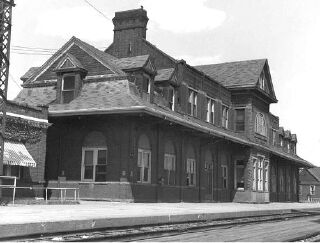
"The Tunnel" GTW Depot, PH, built 1891

This substantial historic railroad depot (Grand Trunk Western) built in 1891, was torn down in 1975, yet the lot remains empty.

By Vicki Priest (enlarged and edited on 3/31/16)

Buildings aren’t people, yet buildings can be unique, beautiful, contain rare materials and can be a face in the community for centuries.  A building can represent a street, a community, a city; it can inspire awe and any number of other feelings or thoughts that make us realize that we can create something beautiful.  Buildings can be the opposite, too.  They can remind us of failing economies and the loss of community pride, as when a school falls into disrepair, or when newer buildings are simple, cheap, cookie-cutter, letting us consider how we now live in a throw-away culture.  For example, 805 Pine Grove Avenue used to be the home of an astonishingly handsome home (Second Empire style), but in its place now is an abandoned gas station.

Pine Grove Ave, PH, 2016

Abandoned gas station at 805 Pine Grove Avenue, Port Huron, today (2016).
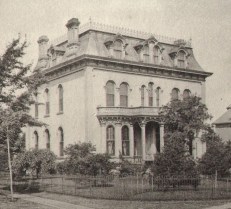
Dead house, 805 Pine Grove Ave, PH

An early and astonishing Port Huron home, demolished (!) in 1970. 805 Pine Grove Avenue.


Looking through images of houses and churches that have been razed in Port Huron, I was negatively impressed by the loss of some of the city’s most notable architecture.  It’s very hard to imagine how it could’ve been thought that tearing such structures down was better than brainstorming ways to repurpose them.  Other structures were lost due to neglect and fire. Below is a very sad example of the urban downscaling that has happened in Port Huron.  The first image is of an undated photo, showing a block of historic buildings on the left (one of them was quite unique), with the second image showing them all to be gone.  (These images will be updated when more information and better quality photos are acquired.)

Military and Wall streets, Port Huron

With the Harrington Hotel at the right, this view is of a block of historic structures at Military and Wall streets (NW corner), Port Huron. The sidewalk and streets are of brick pavers. Undated photo from Gaffney (2006, p 24).

Military street at Wall Street, NNW view, Google

The same scene in 2013 as the historic image shows, though with a different type of lens. No historic buildings at the left remain. From a Google street view image.

Some homes made way for the primary hospital in town.  While time doesn’t stand still and communities grow, the homes torn down for the hospital expansion didn’t have their windows and other structural and architectural components removed for recycling purposes (for use in other historic structures that need replacements).  Below are some examples.  An inventory of lost resources will be listed in the Lost Properties page.

1st Baptist Church, PH, now a parking lot

First Baptist Church, dedicated in 1882 (the church had an earlier building that had burned down). Sold in 1969 to make a parking lot.

The beautiful church structure at left was considered the “crown jewel” of downtown Port Huron (Creamer 2006).  It was sold to the city in 1969 and subsequently demolished; there is now a parking lot in its place.

Maccabees headquarters, Port Huron.

The original Knights of the Maccabees headquarters, built in 1892. It later became the Algonquin Hotel. It met its unfortunate demise in 2000, when it burned down after having been abandoned. Photo from c. 1905.


Below are the homes mentioned earlier, demolished in 2006 for the hospital expansion.  They do not appear to have had valuable components removed first.

Razed house, Pine Grove Ave, Port Huron

The 1300 block of Pine Grove Avenue, Port Huron, 2005, prior to their 2006 demolition.

Demolishing 1327 Pine Grove Ave., PH

1327 Pine Grove Avenue being demolished. June 2006. The smashed remains of the regal 1323 home are to the left.

Razed Lauth Hotel, Port Huron

The Lauth Hotel, built in 1902. Date of photo unknown.

Very few of the original hotels in Port Huron remain today.  Sadly, the “skinny” Lauth Hotel (and bar) no longer stands.  “Built to resemble the famed Flat Iron Building in New York City in 1902, it was destroyed in the Urban Renewal Movement of the 1970’s” (Gaffney, accessed Feb 2016).  Instead of creatively integrating it into condominium architectural plans, it was simply razed.  The whole area where it stood used to be an attractive little city center with brick pavers, but not any more.

__________________

PS.  A local authority had told me of this house, and having discovered specifically which house it was in Port Huron, I wanted to append it to this article.  St Joseph Catholic Church had owned it and then demolished it, despite it being in the city’s Olde Town Historic District.  Believers are called to be stewards of God’s creation, and quality buildings are made of choice and rare materials that God provided.  The workmanship required to make such structures may also be considered a gift from God.  Apparently, the community wanted this structure saved, the city offered them free amenities, and there was even someone who wanted to move it.  Yet the church acted ungraciously (from what I’ve been told) and tore the building down anyway.  Why such waste when it could’ve been removed instead?  There is nothing but grass there now.  There are many reasons why The Church has dwindled in the last decades, and this attitude of disregard–for others in the community and for God’s gifts–could be one of them.
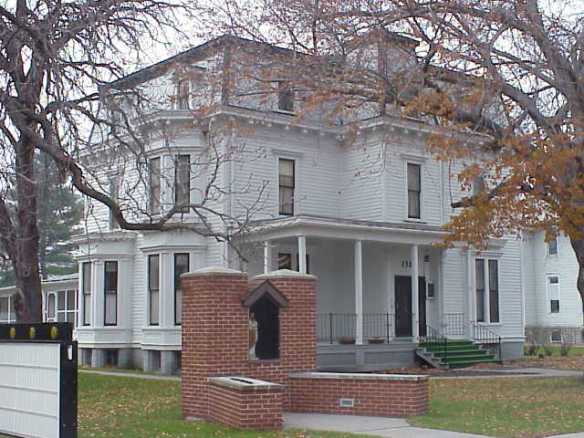
317 Seventh St, Port Huron, demolished

1317 Seventh Street, Port Huron. The church that demolished it, which was on an adjacent lot, even took over the address of the disappeared.

Sources

Bromley, Suzette (former curator for the Port Huron Museum), Rootsweb page, which holds scanned images from various collections held by the Port Huron Museum, and the Library of Congress.

Creamer, Mary Lou (and the History and Research Committee of the Port Huron Sesquicentennial Steering Committee, c. 2006), Port Huron: Celebrating Our Past, 1857-2007.

(TJ) Gaffney’s Pinterist page

Gaffney, TJ, Port Huron, 1880-1960 (Charleston: Arcadia Publishing, 2006).

Olde Town Historic District

PhoenixMasonry.org